
Summary
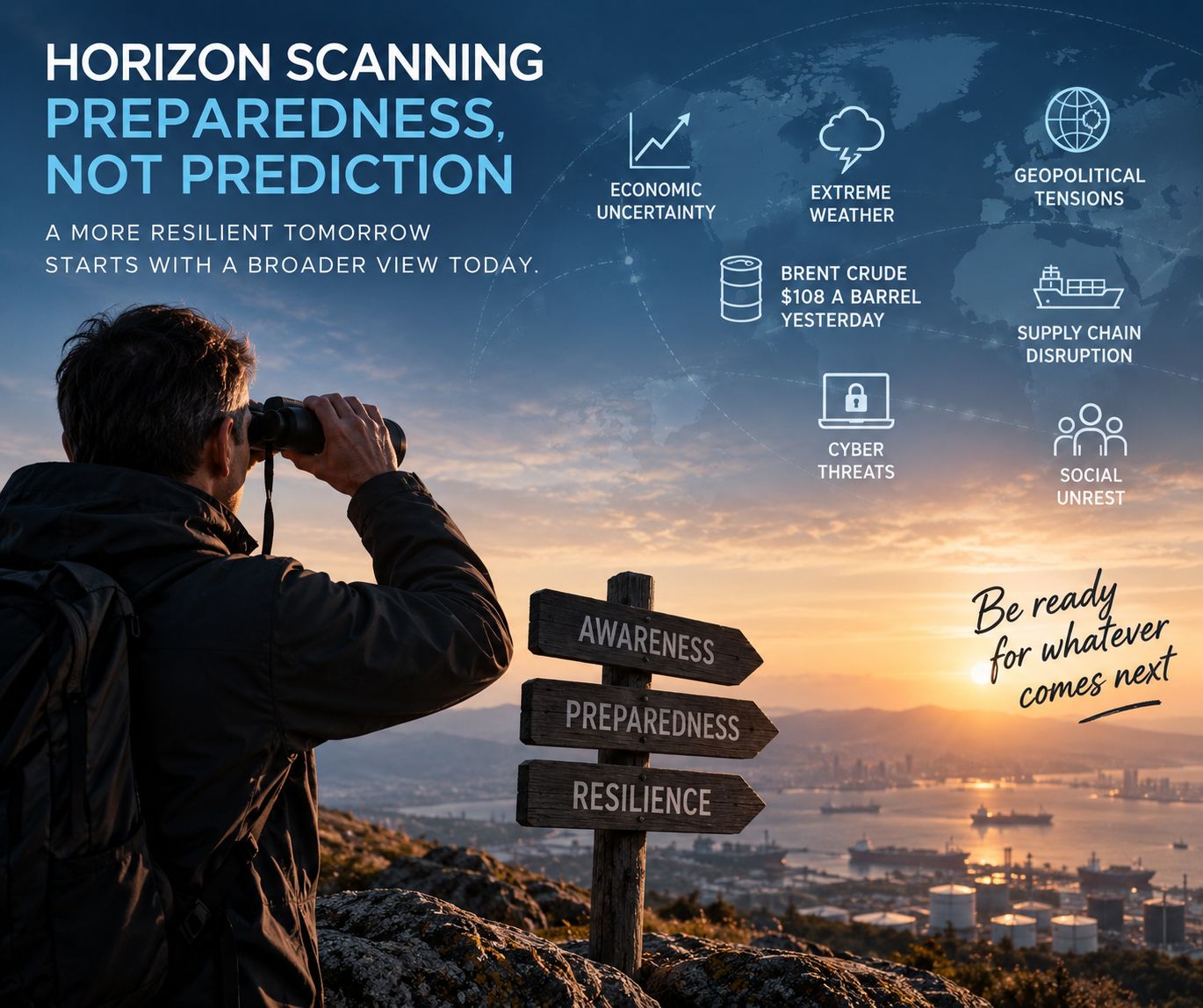
Horizon scanning isn’t about predicting the future, it’s about being ready for it. Why preparing for disruptions that never arrive is rarely wasted effort, and how to make that case to senior leadership.
I was sitting in the car listening to the latest news on the radio whilst waiting for my daughter to finish hockey and started contemplating the challenges of horizon scanning in an increasingly unpredictable global environment (yes, my life really is that exciting). I came to the conclusion that horizon scanning isn’t really about predicting the future; it’s just about being better prepared for it.
I know there is nothing earth-shattering in that, but since the price of Brent crude traded above $108 a barrel recently, it reinforced the fact that events thousands of miles away can rapidly translate into energy, supply-chain, financial and operational pressures much closer to home, thereby making horizon scanning increasingly important – but also creating a challenge.
Specifically, what happens when the things you identify don’t happen? Does that mean your horizon scanning was poor – or that you were wrong to do it at all?
Absolutely not.
The BCI’s Good Practice Guidelines place horizon scanning within Professional Practice 3 – Analysis, recognising its role in identifying current, emerging and ‘over-the-horizon’ risks.
The key word being risk – not prediction.
One of the challenges for resilience professionals is communicating that distinction to senior leadership.
If several anticipated disruptions fail to materialise, there is a danger of the ‘boy who cried wolf’ effect: we prepared last time, and nothing happened, so why should we act this time?
But that misses the point.
Good horizon scanning should trigger proportionate preparedness, not panic.
Reviewing plans, checking suppliers, challenging assumptions and reminding people of their roles is rarely wasted effort. Even if the anticipated event doesn’t occur, those actions strengthen preparedness for the disruption that eventually does.
So perhaps we shouldn’t judge horizon scanning by how many predictions came true.
We should judge it by whether it helped the organisation become more aware, better prepared and more resilient.
Because in an unpredictable world, the objective isn’t to predict exactly what happens next.
It’s to be ready for whatever does.